Twenty-nine counties, home to over 3 million North Carolinians, conducted property tax reappraisals in 2025 after several years of rising real estate prices. Not surprisingly, these reappraisals produced substantial stress among taxpayers and lots of local news headlines:
Tax Anxiety Rises After Johnston County Sends Property Reappraisal Notices
Cumberland County Homeowners Eyeing Wallets as Property Values Rise
Beaufort County Residents Voicing Concerns Following 2025 Property Tax Revaluation
Proposed Lower Tax Rate Won't Lower Tax Bills for Some Brevard Residents
It’s true that all of these reappraisals increased both appraisal values and tax bases for those counties and their municipalities. But a local government’s property tax bill (aka tax levy) has two components, the tax base and the tax rate. The fact that a local government’s tax base increases due to a reappraisal does not guarantee an increase in the total tax levy. It depends on what the local government does with its tax rate following that reappraisal.
To see if taxpayer fears over massive increases in their property tax bills were realized, I conducted an informal study of the 2025 reappraisal counties. The result? Yes, county tax levies usually rise after reappraisals, but not nearly as much as taxpayers fear.
A quick refresher for non-tax professionals: a reappraisal occurs when the county assessor creates new tax appraisals (values) for all real property (land and buildings) located in the county. Reappraisals are required at least once every 8 years; about two-thirds of our 100 counties conduct them every 4 years and about one-quarter of counties conduct them every 8 years. The Department of Revenue lists the dates of the most recent reappraisal and the next scheduled reappraisal for every county here. Read more about the reappraisal process here.
To help the public compare tax levies and tax rates before and after a reappraisal, state law requires every local government to calculate and publish a “revenue neutral tax rate” following a reappraisal.
The revenue neutral tax rate (“RNTR”) is the rate that would keep the local government’s tax levy the same given the new post-reappraisal tax base. If the local government’s tax base increases because of a reappraisal, as is usually the case, the RNTR will be lower than this year’s tax rate. If the local government’s tax base decreases due to a reappraisal, as occurred for a number of counties after the Great Recession of 2008-10, then the RNTR will be higher than the existing rate.
Read this blog post and the bulletins linked therein to learn more about revenue neutral tax rates.
While a local government must calculate and publish a RNTR after a reappraisal, it is not required to adopt the RNTR as its tax rate for the coming fiscal/tax year. It is free to adopt whatever tax rate it chooses (subject to a limit of $1.50, but no local government is close that that maximum; the highest county tax rates have been just under $1.00 in recent years.)
Even if a local government were to adopt the RNTR as its new tax rate, that action would not guarantee that every taxpayer's new tax bill will remain the same as the prior year. If a taxpayer's property appreciated in value at a larger rate than did the average property in the county, then that taxpayer's new tax bill would be larger than their prior year's bill.
In 2024, I analyzed the two most recent reappraisals for all 100 North Carolina counties to see how post-appraisal tax rates compared to RNTRs. My conclusion: two-thirds of the time counties adopt post-reappraisal tax rates that exceed their RNTRs. Read more details of that study here.
I conducted a similar analysis of the 2025 reappraisal counties to see if the trend of local governments adopting post-reappraisal tax rates above RNTRs continued. It did.
As the table below illustrates, 23 of the 29 counties that conducted 2025 reappraisals adopted rates greater than their RNTRs. Two counties adopted rates lower than their RNTRs. Four counties adopted their RNTRs as their actual tax rates.
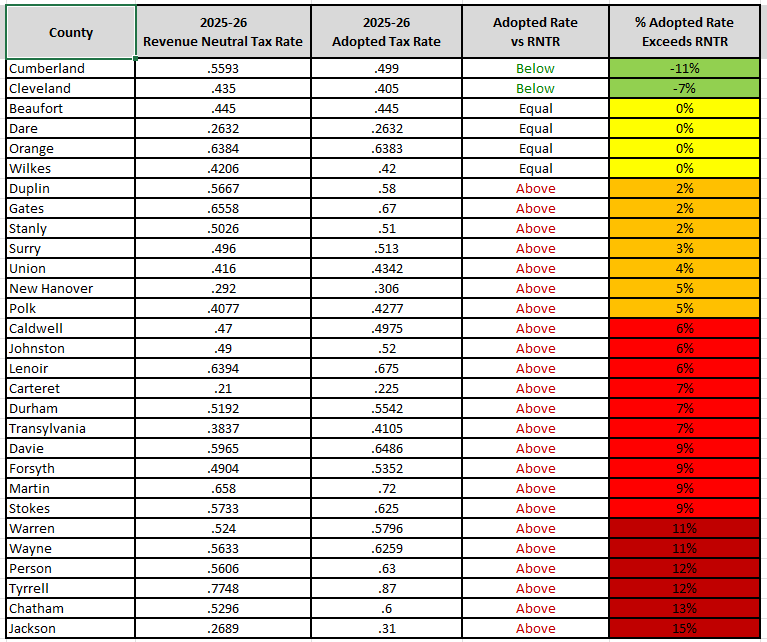
The average adopted tax rate was 5% greater than the average RNTR. In other words, the new tax levy for the average county that conducted a reappraisal in 2025 was 5% greater than the prior year’s tax levy.
Tax rate data for municipalities in these reappraisal counties show similar results, with even larger levy increases. Of the fourteen cities for which I could find reliable information, thirteen adopted tax rates greater than their RNTRs. The average adopted tax rate exceeded the average RNTR by 18%.
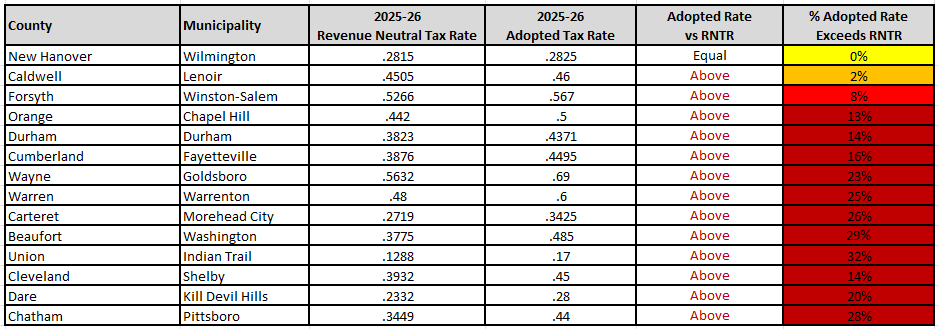
[Note that both tables represent the most accurate data I was able to obtain as of March 2026. If you have different data for any of these local governments, please share it with me at mclaughlin@sog.unc.edu.]
The bottom line: this study and my more detailed 2024 study demonstrate that local governments usually increase their tax levies following reappraisals. However, they do not raise them anywhere near as much as taxpayers initially fear. Despite anecdotal stories of tax bills doubling (or worse) after a reappraisal, the largest 2025 tax levy increase my data showed was 15% for counties and 28% for municipalities.
Are these increases justified? Should local governments be limited in their ability to increase their tax levies? These are policy questions for voters, local governing boards, and perhaps the General Assembly to answer.
Recently several North Carolina House of Representatives proposed a state constitutional amendment that would require the full General Assembly to adopt limits on local government tax levy increases. There is no guarantee that the proposed amendment will be approved and sent to the voters this fall, or that voters will approve the amendment, or what kind of levy limitations the General Assembly might pass in response to the amendment. (Note that the General Assembly does not need a constitutional amendment to limit local tax levies; it could do so today if a majority of its members so desired.) But this proposal, along with several other bills introduced during this legislative session, demonstrates that the General Assembly is very interested in how local governments are taxing their residents. Stay tuned to see where that interest leads.
